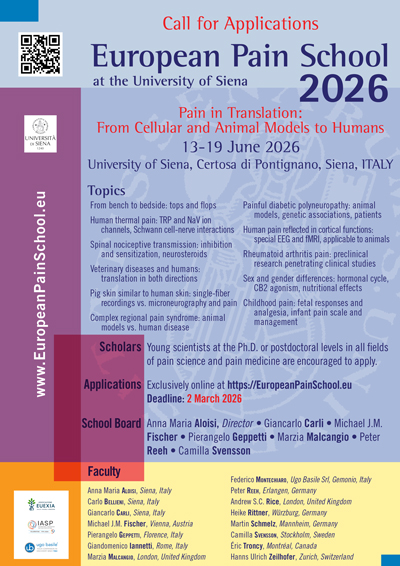

European Pain School®
at the University of Siena
European Pain School®
at the University of Siena
European Pain School®
at the University of Siena
European Pain School®
at the University of Siena
EPS 2026 • Pain in Translation: From Cellular and Animal Models to Humans
Siena, Italy • 13-19 June 2026
Pain in Translation:
From Cellular and Animal Models to Humans
Siena, Italy • 13-19 June 2026
Pain in Translation:
From Cellular and Animal Models to Humans
Siena, Italy • 13-19 June 2026

The European Pain School (EPS), founded at the University of Siena (Italy) in 2002, is the first and still the premier school intended for students working on basic science and clinical topics related to acute and chronic pain. EPS has an interdisciplinary perspective and a distinct research orientation. Young scientists at the Ph.D. or postdoctoral levels (or equivalent) in all fields of pain science and pain medicine are encouraged to apply.
In the past the basic mechanisms of pain and the neural pathways involved were explored through research on animals and human subjects using well defined noxious stimuli and observing neurophysiological, behavioral and subjective sensory responses. This straightforward approach, however, is not sufficient to understand most of the real-life spontaneous and prolonged pain states that occur in human patients and animals. Rather, chronic pain involves complex and nonlinear functioning of neural and extraneural systems resulting in the maintenance of the pain process.
Long known are inflammatory mechanisms that can induce a prolonged pain state mediated by pain-producing substances of multiple origin including the immune system, with cytokines stimulating peripheral nociceptors or neurons of the central somatosensory system. Prolonged and enhanced activation of the central pain system may also be due to failure of inhibitory controls in the CNS, a likely mechanism in neuropathic pain. Control by both GABA and endogenous opioids may be affected, causing persistent pain and allodynia. Altered control may also be mediated by cytokines released from activated astrocytes and microglia in the CNS.
The mammalian pain system shows a clear sexual dimorphism that may depend on hormonal influences during peri- and postnatal nervous system development, among other causes. This sexual dichotomy has consequences for pain expression and for psychosocial and medical consequences of pain in males and females, including e.g. the process of pain chronification. Recognition of this dichotomy is resulting in developments in pain medicine that take gender into account.
The European Pain School believes in the advancement of interdisciplinary programs for the ultimate benefit of pain patients, disseminating this vision especially among junior investigators interested in basic and clinical research on pain.
The great divide that separates preclinically promising compounds from successful analgesic drugs in the clinic blurs the vision of several gaps on either side. Disparities such as differences between animal species and disease models, discrepancies between sensory neurons in culture and their own nociceptive nerve endings, and variations in culture conditions or differentiation procedures for induced pluripotent stem cells can thwart the translation to the human. On the other side, differences between healthy volunteers and patients, experimental and pathologic pain, artificial and “real” inflammation, sex and pharmacogenetic differences, and the great variety of painful conditions and comorbidities complicate the evaluation of analgesic efficacy. Last but not least, the differential weighting of adverse drug effects can result in the premature dismissal of a potentially useful compound.
The 23rd edition of the European Pain School, which will take place from 13–19 June 2026, will address many of the hurdles on translational pathways from bench to bedside. Seven leading experts, basic and clinical scientists, will give two lectures each. Five of these experts conduct research on both sides of the great divide. Half of overall 17 lectures will deal with the current state of pain research from the lecturer’s point of view, the other half is meant to focus on the specific translational theme. School applicants (PhDs and PostDocs) are not bound to the theme, they present their plans or results in pain research in abstract form and short talks, discussed by the whole audience.
Anna Maria Aloisi, Siena, Italy
Carlo V. Bellieni, Siena, Italy
Giancarlo Carli, Siena, Italy
Michael J.M. Fischer, Vienna, Austria
Pierangelo Geppetti, Florence, Italy
Giandomenico Iannetti, Rome, Italy
Marzia Malcangio, London, United Kingdom
Federico Montechiaro, Ugo Basile Srl, Gemonio, Italy
Peter Reeh, Erlangen, Germany
Andrew S.C. Rice, London, United Kingdom
Heike Rittner, Würzburg, Germany
Martin Schmelz, Mannheim, Germany
Camilla Svensson, Stockholm, Sweden
Éric Troncy, Montréal, Canada
Hanns Ulrich Zeilhofer, Zurich, Switzerland
School Executive Board
School Director
Anna Maria Aloisi
Siena, Italy
Scientific Programme Directors
Peter Reeh
Erlangen, Germany
Michael J.M. Fischer
Vienna, Austria
Further Members
Giancarlo Carli
Siena, Italy
Pierangelo Geppetti
Florence, Italy
Marzia Malcangio
London, United Kingdom
Camilla Svensson
Stockholm, Sweden
Applications open:
10 December 2025
Applications deadline:
EXTENDED TO
20 March 2026
Notification of selections:
27 March 2026
Deadline for attendance confirmation:
31 March 2026
Deadline for payment:
30 April 2026
With the support of


EPS 2025 • Cancer Pain (7-13 June 2025)
EPS 2024 • Pain and the Immune System (9-15 June 2024)
EPS 2023 • Neuro-immune Interactions in Nociception, Pain and Itch (10-17 June 2023)
EPS 2022 • Pain, Inflammation and the Guts (11-18 June 2022)
EPS 2021 • Pain, Inflammation and the Guts (Online, 14-19 June 2021)
EPS 2020 • Pain, Inflammation and the Guts (rescheduled)
EPS 2019 • Headaches and Facial Pain (9-16 June 2019)
EPS 2018 • Pain: from Fetus to Old Age (10-17 June 2018)
EPS 2017 • CNS vs PNS Contributions to Persistent Pain (4-11 June 2017)
EPS 2016 • Pain: Neurons, Gender and Society (5-12 June 2016)
EPS 2015 • Plasticity in neural processing as a mechanism in chronic pain (7-14 June 2015)
EPS 2014 • Spontaneous versus Evoked Pain in Animals and Humans (8-15 June 2014)
EPS 2013 • Brain Modulation of Pain Experience (9-16 June 2013)
EPS 2012 • Evolution of Concepts on Pain (3-10 June 2012)
EPS 2011 • Pain: Bridging Molecules and Mind (12-19 June 2011)
EPS 2010 • Translating Pain Science into Pain Medicine (30 May - 6 June 2010)
EPS 2009 • Molecular Mechanisms of Pain Response (13-20 June 2009)
EPS 2008 • Hyperexcitable Neurons as Pain Generators (15-22 June 2008)
EPS 2007 • Pain Syndromes: Science and Medical Practice (17-24 June 2007)
EPS 2006 • Pain and the Central Nervous System (12-17 June 2005)
EPS 2005 • Chronic Pain a Disease: The Role of Genes (6-11 June 2005)
EPS 2003 • Chronic Pain a Disease: Novel Scientific Concepts (25-31 October 2003)